

Choosing a web host is a different decision for a small or medium business than it is for a personal blog. A business site carries more weight it’s often the first place a potential customer forms an opinion, it may need to handle payment forms or bookings, and downtime doesn’t just mean an inconvenience, it means lost enquiries and lost revenue. That changes what actually matters when comparing hosting providers: uptime and support response times start to matter more than the lowest possible monthly price.
This verpex hosting review looks specifically at how Verpex holds up against that standard not just what the marketing page claims, but what the infrastructure, pricing, and real customer feedback actually show.
What Is Verpex?
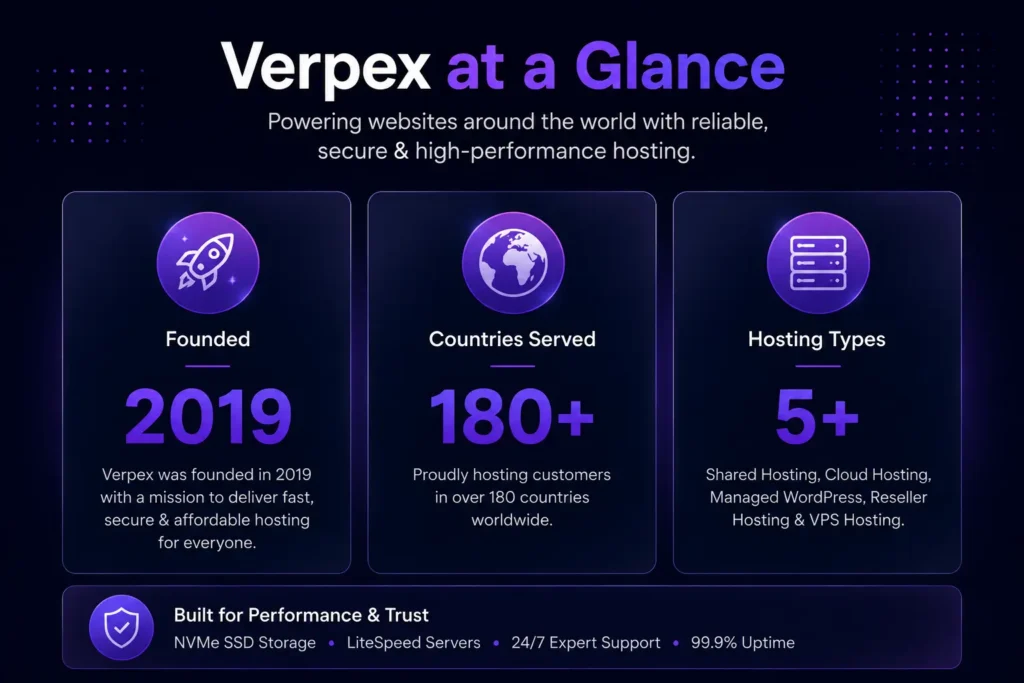
Verpex is a UK based hosting provider, founded in 2019, that has grown to host several hundred thousand websites across more than 180 countries. It offers shared hosting, cloud hosting, managed WordPress, reseller hosting, and VPS plans, with infrastructure built on LiteSpeed web servers and NVMe SSD storage rather than the older SSD/Apache combination still common among budget hosts.
For a business owner who isn’t deeply technical, the more relevant question isn’t what technology sits under the hood it’s whether that technology translates into a site that loads quickly and stays online. That’s what the next few sections dig into.
Performance and Uptime: What the Numbers Actually Show
Verpex advertises a 99.9% uptime guarantee. Independent hosting review sites that run ongoing performance monitoring tracking real load times across large numbers of sites rather than relying on marketing claims have measured Verpex performing at or slightly above that figure, with some benchmarks reporting uptime closer to 99.95%.
The infrastructure behind that number is fairly straightforward: NVMe SSD storage (notably faster than standard SSD for read/write operations) and LiteSpeed web servers, which are known to handle concurrent traffic more efficiently than the Apache setups still used by many budget hosts. In practical terms, that combination tends to matter most during traffic spikes a promotion, a press mention, a busy trading period which is exactly when a small business site can least afford to slow down or fall over.
Data centres are available across multiple regions, including the US, UK, Singapore, and India. There is currently no data centre located in South Africa, so businesses hosting primarily for a South African audience should factor in the latency of whichever region they select, though this is true of the large majority of international hosting providers, not a Verpex-specific limitation.
Pricing: What It Actually Costs Over Time
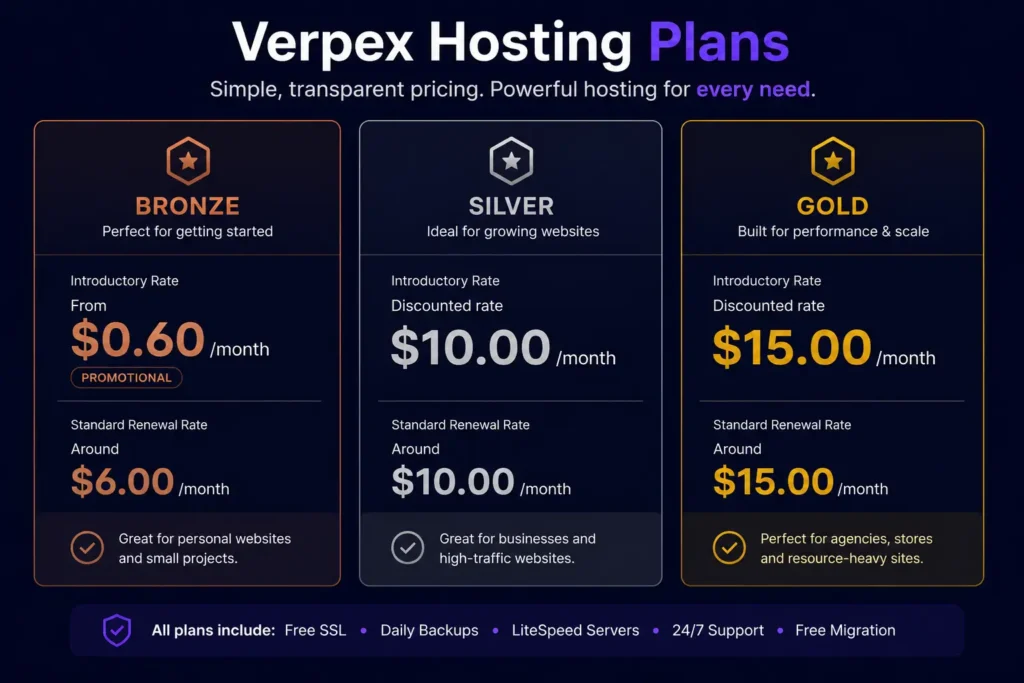
This is where a lot of hosting reviews stop short, so it’s worth being specific. Verpex’s shared hosting plans are structured in three tiers Bronze, Silver, and Gold with aggressive introductory pricing that’s clearly designed to get businesses in the door:
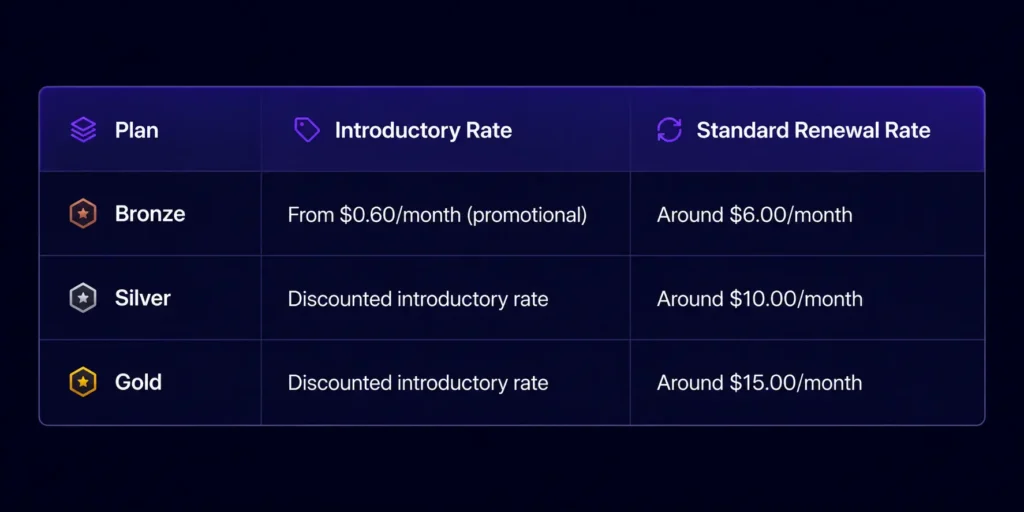
(Renewal pricing is based on published benchmarks as of 2026 always confirm current figures directly on Verpex’s pricing page, as hosting prices are revised periodically.)
The pattern here isn’t unusual in the hosting industry, but it’s one small businesses in particular should budget around: the lowest advertised rate typically requires a longer commitment (often 24–36 months), and the renewal price what you’ll actually pay from year two onward is several times higher than the intro rate. None of that makes Verpex expensive by industry standards; the renewal rates above are still broadly in line with, or below, many competitors. It simply means the number on the homepage isn’t the number to budget against long term.
Security, Backups, and Support: The Features That Matter for Business Continuity
For a business site, the features that matter most usually aren’t the flashiest ones. Verpex includes the following as standard, rather than as paid add-ons:
- Free SSL certificate on all plans
- Daily automated backups
- Built-in malware scanning and DDoS protection
- cPanel control panel, the industry standard, with a low learning curve
- Softaculous one-click installer for WordPress and other CMS platforms
- Free website migration, including full cPanel account transfers
- 24/7 support via live chat, ticket, and phone
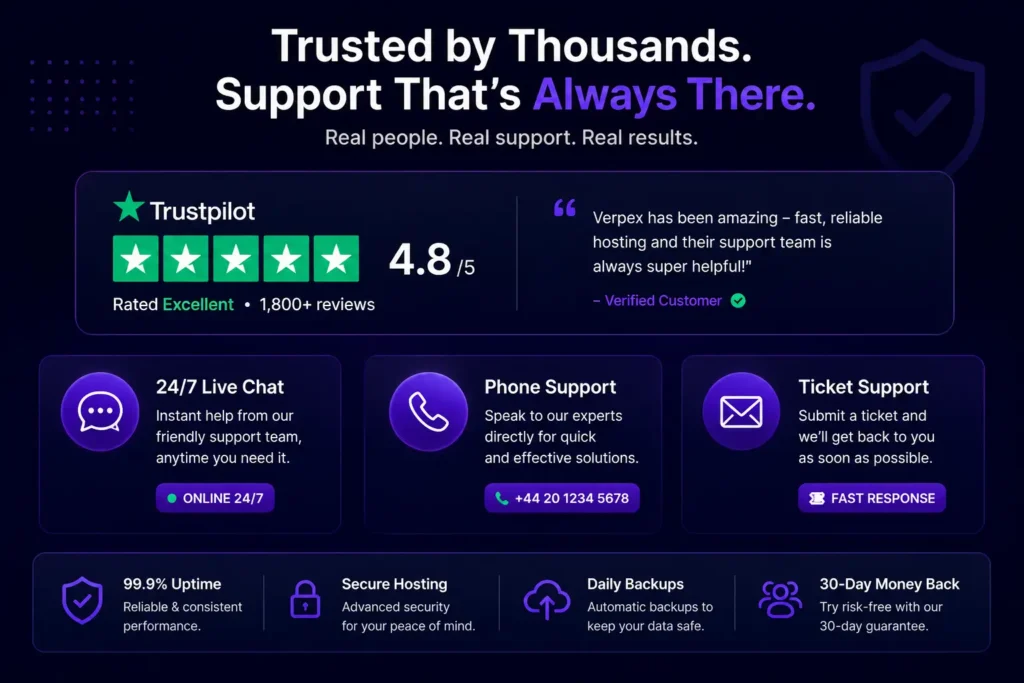
Verpex holds an “Excellent” rating on Trustpilot, sitting between 4.5 and 4.7 out of 5 across more than a thousand reviews at the time of writing. Support responsiveness is the single most repeated theme in that feedback customers frequently mention specific support staff by name and describe fast turnaround on both routine questions and more urgent issues like restoring a hacked or corrupted site.
It’s worth noting the feedback isn’t universally positive, which is generally a good sign that the reviews are genuine rather than curated. A smaller number of reviewers have reported slow ticket response times on time-sensitive requests (domain registrations being one specific example raised), and a handful mention frustration with renewal pricing increases or occasional inconsistency between support agents. For a business evaluating a host, that mix is useful context: the overwhelming majority of feedback points to strong, fast support, but it isn’t guaranteed to be flawless every time.
Is Verpex a Good Fit for Small to Medium Businesses Specifically?
A few features make Verpex a reasonable shortlist candidate for SMBs in particular, beyond the general feature set:
- Free migration removes a real barrier for businesses moving off an unreliable or outgrown host, since the technical work is handled rather than left to the business owner
- Reseller hosting plans are relevant for agencies and freelancers managing hosting on behalf of multiple small business clients, allowing separate cPanel logins under one account
- Developer friendly extras multi PHP version support, Git over SSH, Node.js and Python support, Redis/Memcached caching matter if a business’s site is more than a basic brochure site, e.g. a custom WooCommerce store or a site with custom development
- Daily backups by default reduce the business risk of a single bad plugin update or security incident wiping out weeks of content or orders
Where it’s a weaker fit: businesses that need guaranteed low latency to a South African audience specifically and aren’t able to work around that with caching (e.g. via Cloudflare), and businesses that know they’ll want to cancel or switch within the first year or two, since the best pricing is tied to longer commitments.
Verpex hosting review vs. the Alternatives
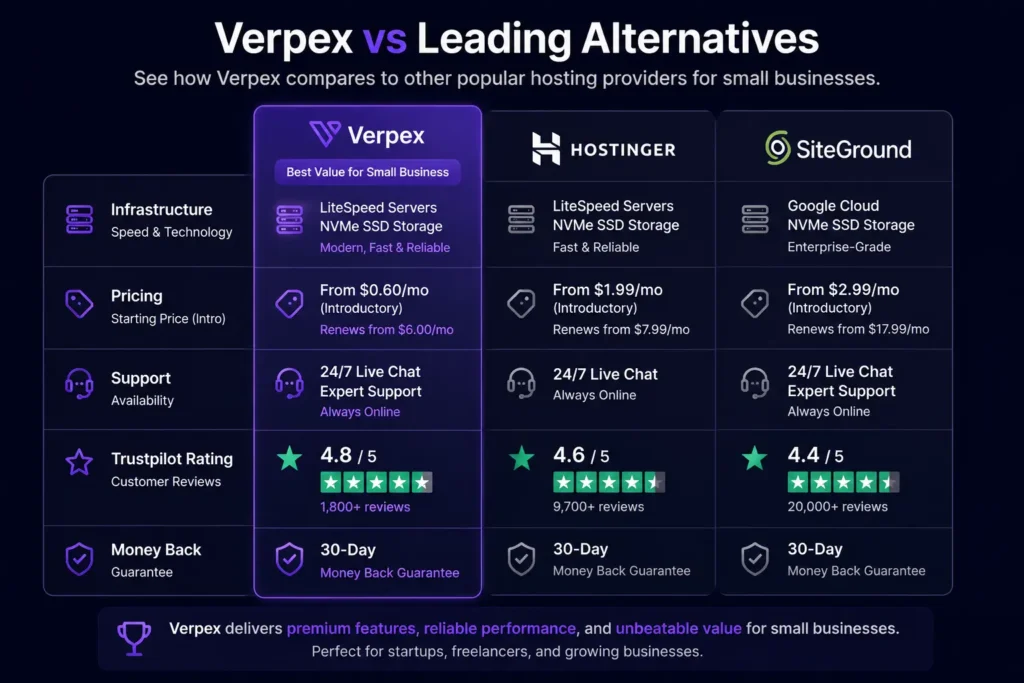
Verpex competes most directly with other budget to midrange hosts like Hostinger. The two are close on price, and both offer 24/7 support and free SSL as standard. Where Verpex tends to differentiate is the underlying infrastructure (LiteSpeed plus NVMe across all tiers, rather than reserved for higher priced plans) and the consistency of its Trustpilot feedback around support quality specifically. Hostinger, in turn, is often cited as slightly more beginner friendly in its dashboard design, and its backup policy varies more by plan tier.
Neither is a clearly “better” choice in the abstract the right one depends on which specific features matter most for a given business, which is exactly why it’s worth checking current plan details on both before deciding rather than going on price alone.
Summary
Verpex holds up reasonably well under closer scrutiny: uptime performance generally matches or exceeds its advertised guarantee, the infrastructure (NVMe SSD, LiteSpeed) is genuinely a step above typical budget hosting, and customer feedback on support is consistently strong, if not flawless. The main things a small or medium business should plan around are the renewal pricing jump after the introductory term and the absence of a South Africa based data centre.
For a business weighing up hosting providers, it’s a reasonable one to include in that comparison. Current plans and pricing are available directly on Verpex’s site: View Verpex’s current hosting plans →